|

About the Evangelical Christian Church
The ECC became a part of The Dayspring Ministry Group in March of 2003.
It is felt that the Lord placed the ECC in the great DMG family so that persons wanting to belong to an historical Denomination
/ Fellowship can have a part in in the ministry of the DMG. The Fellowship goes by the title, Evangelical Christian
Church Worldwide.
Persons who wish to be a part of the ECC are requested to relinquish
other ordination. If a person wishes to maintain their past fellowship alignment he/she will be recommended to the ECC
for "Standing."
Read about the rich history of the ECC and requirements for ordination.
We then invite you to join a fast growing Fellowship which is part of a greater Ministry, DMG.
Statement of Faith....
- God is our Father
- Jesus Christ is our Lord and Saviour
- The Holy Spirit is the power of God
- The Bible is sufficient for faith and practice
The ECC Statement of Faith has been replaced by the
DMI Articles of Faith
ARTICLE VIII. THE SEVEN ARTICLES OF FAITH
We Believe...
...there
is one God eternally existing and manifesting Himself to us in three persons -- Father, Son and Holy Spirit.
...Jesus
Christ is true God and true man. He is our Lord and Savior
...the Holy Spirit
is a divine person, sent to indwell, guide, teach and empower the believer, and convince the world of sin, of righteousness
and of judgment.
...the Old and New Testaments, inerrant as originally given, were inspired by God and are sufficient
for faith and practice.
...Where the Scriptures
speak, we speak; where the Scriptures are silent, we are silent.
...the church consists
of all those who believe on the Lord Jesus Christ, are redeemed through His blood and are born again of the Holy Spirit.
...the
local church is a body of believers in Christ who are joined together for the worship of God, for prayer, fellowship, the
proclamation of the gospel, and the observance of the ordinances of baptism and the Lord's Supper.
To see a current Constitution and Bylaws of the Dayspring
Ministry Group... which is also for all of the groups that are a part of the DMG, please go to the page that says "Forms & Constitution 2018"

History of the Evangelical Christian Church
Our
history began on the American frontier within the various "Christian" church and American Restoration movements and is rooted
in the formal organization of the Christian Church, June 28, 1804, in Bourbon County, Kentucky.
Initially,
churches in and adherents of the Restoration Movement identified themselves as:
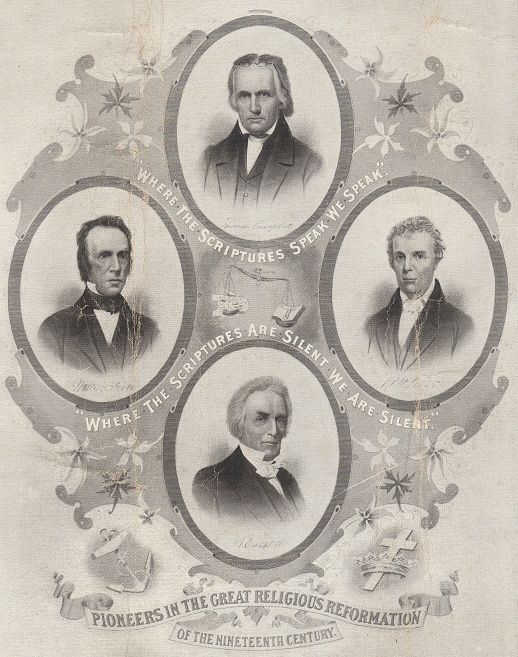
| Four founders of the ECC ... Thomas Campbell |
|
| Alexander Campbell ... Barton Stone ... Walter Scott |
In Laura, Ohio, in 1854, an anti-slavery remnant of the Christian Disciples organized as The Evangelical Christian
Church taking the message of Christ to the black community. A number of The Evangelical Christian Churches invited black ministers
to preach in their pulpits. Many white ministers preached to mixed congregations. Ministers and members were strong supporters
and workers in the Abolition Movement and participated in the Underground Railroad. These views reflected those of Stone.
The early Christian Church was noncreedal and stressed basic beliefs that represent our Statement of Faith that is
simple, Biblical Christianity. In addition to Stone, the early Christian Church also had its origins in the work of two other
former Presbyterian ministers, Thomas and Alexander Campbell.
From these men sprang the present day Independent Christian Church and Churches of Christ, the Christian Church (Disciples
of Christ), the Churches of Christ (non-instrumental) , and the International Churches of Christ.
Unfortunately most of the churches of the American Restoration Movement abandoned many of the teachings of Stone and
became more and more Campbellite. The Evangelical Chrisitian Church remains true to the basic teachings of Stone.
Several church bodies identifying with the Stone-Campbell movement today are very creedal and range from ultra-conservative
to ultra-liberal as can be seen in the United Church of Christ which is an attempt to unite all Christian denominations into
one national body as well as the National Association of Congregational Christian Churches which merged English Christians
with American Christians in 1931. Another group, The Christian Congregation, claims direct lineage to the early Stone movement.
In 1905, nearly all congregations of The Evangelical Christian Church, after great revival activity in Indiana and
Ohio, assimilated into the Evangelical Christian Churches of America, Cleveland, Ohio; the Congregational Church, Boston,
Massachusetts; and, The Christian Congregation, Kokomo, Indiana. The remainder were absorbed into the Disciples of Christ
and various independent Christian churches of the American Restoration Movement.
During the First World War, many Evangelical Christian Churches became independent and a formal organization ceased
to exist until 1966 when churches calling themselves Evangelical Christian Churches, Christian Churches of North America,
Christian Missionary Churches, Bible Evangelical Churches, Community Churches and Evangelical Congregational Churches were
chartered and incorporated as members of the Evangelical Christian Churches, Farmland, Indiana.
Throughout the ‘80’s and ‘90’s the Evangelical Christian Churches were beset by a number of
separations. One group formed the California Conference of the Evangelical Christian Churches, Long Beach, California, now
defunct. A number of Pennsylvania congregations eventually ceased to exist as they united with the Evangelical Christian Church,
Wesleyan, a small holiness denomination formed in 1892, in Philadelphia, Pennsylvania.
The Mid-West Congregational Fellowship, Modoc, Indiana, absorbed a few churches and another group became Trinity Fellowship,
Williamsburg, Indiana. The majority continues as the Evangelical Christian Churches, Albany, Indiana.
The theological history of the Evangelical Christian Churches traces its origin to the teaching and preaching of New
England Congregationalist, Horace Bushnell, generally recognized as a theological liberal. A few former ministers of The Evangelical
Christian Church, disagreeing strongly with the theology of Bushnell, and wanting to return to their Restoration roots, desired
to reorganize The Evangelical Christian Church. On April 4, 2001, The Evangelical Christian Church was formally incorporated
in Indiana.
THE EVANGELICAL CHRISTIAN CHURCH TODAY
The Evangelical Christian Church today proclaims "In things essential, unity; in things nonessential, liberty; in all
things, charity." Therefore, "Where the Scriptures speak, we speak; where the Scriptures are silent, we are silent," forms
the core of our Faith. Frequency of the Lord's Supper and mode of Baptism are left to the discretion of the individual churches.
GOVERNMENTAL POLITY
Evangelical Christian Churches are basically congregationally governed, noncreedal and semi-autonomous. Each local
pastor is under the auspices of his or her Regional Presiding Pastor / Superintendent. The Regional Pastor is under the auspices
of the General Pastor & Bishop who reports directly to the Senior Presiding Pastor & Archbishop. Each local congregation
is free to structure worship as they choose. The only requirement for every local church is that the Statement of Faith be
strictly adhered to and the local church opposes abortion on demand.
While the Evangelical Christian Church opposes capital punishment and military intervention into foreign disputes,
as well as advising against the use of alcohol and tobacco, we cannot force these issues with believers. Suffice that all
Evangelical Christian Church members and pastors know our official policy. All credentialing is through the International
Office.
© COPYRIGHT 2003 ALL RIGHTS RESERVED THE EVANGELICAL CHIRSTIAN CHURCH INC.
|
